
NewAutomation
Parallel
Runs two to five branches of an automation at the same time, then continues once all of them finish, with their results in branch order.
Parallel starts several branches at once and waits for all of them. When the last one finishes, the flow continues from the done handle with every branch's result collected in one list.
When to use it
- Call two or three independent APIs and combine their answers, without waiting for each in turn.
- Notify several systems about the same event (a CRM, a Slack channel, a data store) in one step.
- To run the same steps once per item in a list, use Loop.
- When the branches depend on each other's results, chain the nodes one after another instead.
Automation projects only
Parallel appears only in the palette of automation projects.
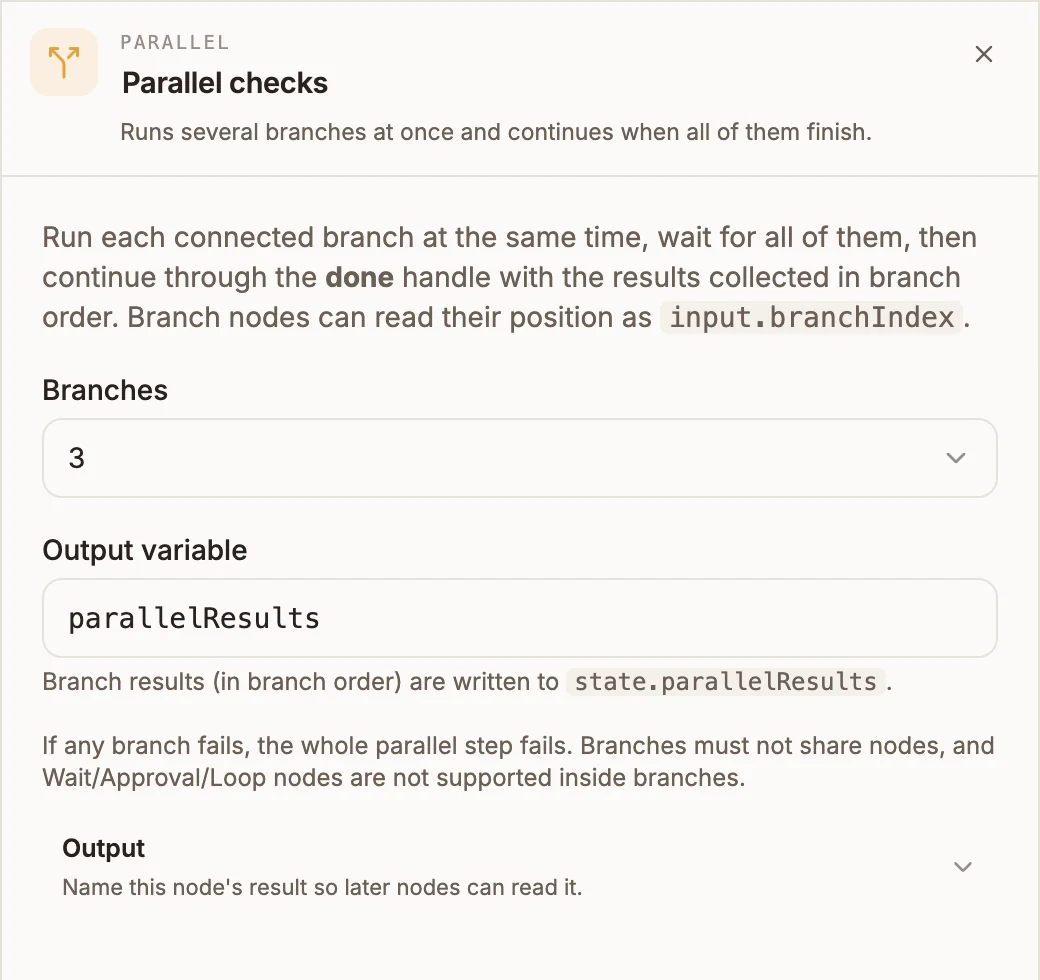
Settings
Prop
Type
Outputs
| Handle | What runs |
|---|---|
| branch 1 to branch 5 | Each connected branch, all at the same time. Each receives the Parallel node's input plus branchIndex. |
| done | Once, after every branch has finished. Its input is the node's input plus the results under the output variable's name. |
{{state.parallelResults}} holds one entry per connected branch: the value that branch's last node returned. The order follows the handles, branch 1 first, no matter which branch finished first. A branch handle with nothing connected is skipped.
Example
When a new lead arrives, an automation enriches it from two services at once:
- Webhook trigger receives the lead.
- Parallel with 2 branches.
- branch 1: API node looks up the company by email domain.
- branch 2: Integration node, HubSpot Create Contact.
- done: Function node merges
state.parallelResults[0]andstate.parallelResults[1]into one record.
Tips and limits
- If any branch fails, the whole Parallel step fails, and the run stops. To keep going when one call fails, turn on the API or Integration node's failure path inside the branch so the branch itself still finishes.
- Branches must not share nodes. Two branches that lead into the same node, or a branch that joins the done chain, fail the publish. Put shared work after done.
- Not allowed inside a branch: Wait, Approval, Collect Payment, Respond Webhook, Loop, or another Parallel.
- Branches share state. If two branches write the same variable, the one that finishes last wins. Give each branch its own output variable names.
input.branchIndexcounts only connected branches, from 0.
Related
Last reviewed 24 September 2026